
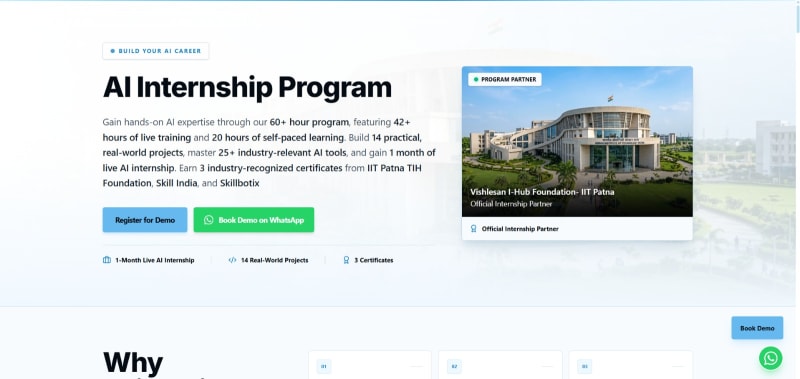
Web Development
Skillbotix Website
Official Skillbotix digital platform showcasing its AI-powered learning, education and skill-development ecosystem.
View ProjectIntelligent workflow automation and system integrations designed to streamline business operations, improve information handling, and reduce repetitive administrative effort.
We assess operational workflows, identify suitable automation opportunities, and implement connected systems using APIs, event-driven processes, and AI technologies. Every solution is designed around defined business rules, operational requirements, and appropriate oversight.
What you get
The agreed scope confirms the exact deliverables, integrations and documentation for your project.
Delivery Standards
Scope clarity, testing, and documented handover.
Example in practice
An illustrative workflow in the style of tools such as n8n: each node does one job, and conditional branches decide where an enquiry goes next.
Full workflow
Trigger → Validate data → AI classification → Route → Save to CRM → Notify sales.
Select any node to see what it does, with its input and output. Dashed lines and nodes marked Optional, Conditional or Decision point apply only in some cases.
Full workflow
Trigger → Validate data → AI classification → Route → Save to CRM → Notify sales.
Select any node to see what it does, with its input and output. Dashed lines and nodes marked Optional, Conditional or Decision point apply only in some cases.
Optional path: Without the AI step → Route
If: Incomplete
Corrected: back to Validate data
If: Needs approval
Approved: back to Save to CRM
If: On failure
Retry: back to Save to CRM
Illustrative example only. It is not a specific client project; the actual steps, tools and integrations are agreed during scoping for each engagement.
Discuss your workflowWe evaluate existing workflows, integrate business systems, and apply AI where it supports operational requirements and measurable objectives.
Evaluate current workflows, identify repetitive activities, document dependencies, and establish opportunities for operational improvement.
Connect approved applications, implement rule-based processes, configure notifications, and establish reliable data transfer between systems.
Introduce appropriate AI capabilities for information retrieval, classification, document processing, and defined actions with validation and human oversight.
Effective automation begins with understanding existing processes, operational constraints, and information flows. We identify repetitive activities and determine which can be addressed through conventional automation, AI assistance, or a combination of both.
Document existing workflows, triggers, and operational handoffs
Identify repetitive administrative and information-processing tasks
Evaluate suitable automation methods and application integrations
Define approval requirements and responsibilities for human oversight
AI-assisted systems can support employees by retrieving authorised information, summarising documents, classifying requests, and preparing responses. Implementation depends on available data, access permissions, and the consequences of inaccurate outputs.
Knowledge assistants connected to approved documents and data sources
Document summarisation and structured information extraction
AI-assisted email and enquiry classification
Permission-aware information retrieval and escalation procedures
Automation can connect business systems and initiate predefined actions in response to approved triggers. These workflows are designed with validation, exception handling, and clear operational boundaries.
CRM record updates and enquiry distribution
Email, appointment, and notification integrations
Structured output validation before downstream actions
Failure alerts, retry policies, logging, and manual recovery procedures
Business automation requires appropriate controls over data access, credentials, external services, and automated actions. We establish safeguards and operating documentation according to the sensitivity and requirements of each use case.
Review of data flows and external AI provider requirements
Appropriate authentication and permission controls
Defined escalation and approval requirements for sensitive actions
Testing of normal operation, exceptions, and failure scenarios
Six phases with a written scope before work starts, previews along the way and documentation at handover.
Related work
Web Development
Official Skillbotix digital platform showcasing its AI-powered learning, education and skill-development ecosystem.
View ProjectChosen for your scope, integrations and long-term maintenance.
Scope, implementation and delivery, answered.
AI Automation & Integrations
Share your goals and requirements. We'll reply with questions or a suggested approach.